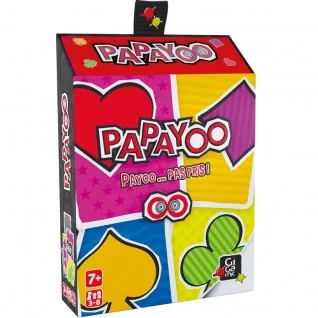
 Photo: BCD Jeux, partner shop
Card games
Papayoo
Gigamic2010
- players
- 3–8
- minutes
- 30
- years
- 7+
In the box
60 cards: 4 colours from 1 to 10 and 20 Payoo · 1 die
Where to buy it
Near you and online
In a shop
Within 50 km.
Online
Affiliate link: Marquoir may earn a commission, at no extra cost to you.
The basics
Collect as few points as possible in tricks where everything you take costs you. After passing cards to your neighbour and rolling the die that picks the papayoo, tricks are played following the suit led when you can, the highest card of the suit led winning the trick; when you cannot follow, you may slip in a payoo or the papayoo. Each payoo costs its value, the papayoo 40, and after the agreed number of rounds, the lowest total wins.
Checked against the official rules · September 2026
The rules, step by step
Setup
Everything dealt, Die picks the papayoo, 3 to 8 players
- Three to eight players. A 60-card deck: four classic suits from 1 to 10, plus twenty payoos numbered 1 to 20, and an eight-sided die.
- With seven or eight players, remove the four 1s of the classic suits to play with 56 cards.
- All the cards are dealt out: 20 each with three players, 15 with four, 12 with five, 10 with six, 8 with seven, 7 with eight. The dealer changes every round.
- Once the cards have been passed, the dealer rolls the die: the 7 of the suit shown becomes the papayoo for the round.
How to play
Pass cards, Follow suit
- Each player passes cards, face down, to their left-hand neighbour, before looking at the ones received from their right-hand neighbour: five cards with three or four players, four with five or six, three with seven or eight.
- The dealer leads the first trick. Play then goes clockwise, following the suit led when you can, with no obligation to play higher.
- If you cannot follow the suit led, play any card you like: a chance to slip in a payoo or the papayoo.
- Payoos form a fifth suit, played exactly like the others: it can also be led.
- The trick goes to the highest card of the suit led, and whoever takes it leads the next one.
Scoring
Payoo: its value, Papayoo: 40, 250 points per round
- Each payoo taken costs its value, from 1 to 20: that makes 210 points in play.
- The papayoo, that is the 7 of the suit shown by the die, costs 40.
- The other cards cost nothing.
- A round therefore hands out 250 penalty points.
End of the game
Rounds set at the start, Often 5 rounds, Lowest total
- The number of rounds is set at the start of the game: five for a game of medium length.
- The lowest total after the last round wins.
- Common house variant, outside the rules: play until a player passes a threshold set in advance.
House rules and pitfalls
The papayoo changes suit every round: the card that costs forty points is never the same twice in a row.
- The papayoo changes suit every round: the card that costs forty points is never the same twice in a row.
- You cannot discard a payoo while you hold the suit led: you have to wait until you run out of it.
- Taking a few points when the stakes are low lets you get rid of your high cards before the dangerous tricks.
Going further
Frequently asked questions · In the same family · Play with the game assistant
Frequently asked questions
What is the goal?
Avoid collecting penalty points: it is an avoidance game where the lowest total wins, like Hearts.
Which cards cost points?
All cards of the "payoo" suit cost their face value in penalties, and the Papayoo (the 7 of the suit shown by the die) alone is worth 40 points. The other cards cost nothing.
How does a round go?
A simple trick-taking game: follow the suit led, the highest card wins, and the trick winner takes it — and so collects the penalties it contains.
Do you have to follow suit?
Yes. Without the suit led, discard whatever you like: a chance to pass your payoo cards to someone else.
How does the game end?
Penalties add up over the number of rounds agreed at the start, usually five. The player with the lowest score wins.