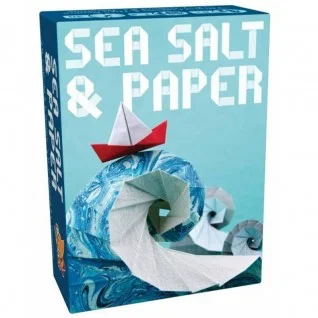
 Photo: BCD Jeux, partner shop
Card games
Sea Salt & Paper
BombyxBruno Cathala, Théo Rivière2022
- players
- 2–4
- minutes
- 30
- years
- 8+
In the box
58 cards
Official rules (PDF, publisher's site)
Box details
- Designers
- Bruno Cathala, Théo Rivière
- Artwork
- Lucien Derainne, Pierre-Yves Gallard
- Publisher
- Bombyx
- Mechanics
- Hand ManagementMeldingOpen DraftingPush Your LuckSet Collection
- Expansions
- Sea Salt & Paper: Extra Salt · 2023
- Sea Salt & Paper: Extra Pepper · 2025
Where to buy it
Near you and online
In a shop
Within 50 km.
Online
Affiliate link: Marquoir may earn a commission, at no extra cost to you.
The basics
Collect origami cards and decide when to end the round, at just the right moment. On your turn, take two cards from the draw pile and keep one, or take the top card of a discard pile, then you may play duos for their effect; with at least 7 points, you may end the round by calling STOP or LAST CHANCE. At 40, 35 or 30 points depending on the number of players, the game ends and the highest total wins; four mermaids played win immediately.
Checked against the official rules · October 2026
The rules, step by step
Setup
Single draw pile, 2 face-up discard piles, Empty hand at start
- 58 cards and six player aids, for two to four players.
- Shuffle all the cards to form a single draw pile, face down.
- Turn over the top two cards next to the draw pile: they start two discard piles.
- Each player starts with no cards in hand. The first player is chosen at random.
How to play
Take a card, Play duos, End round at 7+ points
- Play goes clockwise. On your turn, you must first take a card, in one of two ways.
- Either take the top two cards of the draw pile, keep one and place the other face up on the discard pile of your choice (on the empty discard pile if there is one).
- Or take the top card of one of the two discard piles. You may not look through the discard piles.
- You may then play as many duos as you like in front of you, applying their effect each time.
- Crab duo: choose a discard pile without looking at it, then look through it and take one card, without changing the order of the others or showing your choice.
- Boat duo: immediately take another turn.
- Fish duo: add the top card of the draw pile to your hand.
- Swimmer and shark duo: steal a random card from an opponent's hand.
- Finally, if you have at least 7 points counting your hand and your played cards, you may end the round by calling STOP or LAST CHANCE.
- If the draw pile is empty at the end of a turn, the round ends immediately and nobody scores.
- The next round, with all the cards shuffled again, starts with the left-hand neighbour of the player who ended the previous one.
Scoring
Duos: 1 point, Collections and mermaids, STOP: everyone scores
- Always count the cards in your hand and those played in front of you.
- Duos: 1 point per pair of crabs, boats or fish, and per swimmer and shark pair, whether played or still in hand. The effect, however, only applies if you play it.
- Shells: 0, 2, 4, 6, 8 or 10 points for 1 to 6 cards.
- Octopuses: 0, 3, 6, 9 or 12 points for 1 to 5 cards.
- Penguins: 1, 3 or 5 points for 1, 2 or 3 cards.
- Sailors: 0 points for one, 5 points for both.
- Mermaid: 1 point per card of the colour you have the most of. Each additional mermaid counts the next most plentiful colour, never the same one twice. Mermaids themselves are white cards.
- Multipliers: the lighthouse is worth 1 point per boat, the shoal of fish 1 point per fish, the penguin colony 2 points per penguin, the captain 3 points per sailor. These cards do not count themselves in the family they multiply.
- Colour bonus: 1 point per card of the colour you have the most of.
- STOP: everyone reveals their hand and scores the points of their cards.
- LAST CHANCE: each opponent plays one last turn, then reveals their hand, which can no longer be targeted by a steal. If the caller has at least as many points as each of the others, they score their cards plus their colour bonus, and the opponents only score their colour bonus. If at least one opponent beats them, the caller only scores their colour bonus and the others score their cards.
End of the game
40, 35 or 30 points, 4 mermaids: victory
- Playing all four mermaids in front of you wins the game immediately.
- Otherwise, the game ends at the end of the round in which a player reaches or exceeds the threshold: 40 points with two players, 35 with three, 30 with four.
- The highest total wins. In case of a tie, the tied player who scored the most points in the last round wins.
Going further
Variants · Frequently asked questions · Rules on video · In the same family
Variants
Threshold by table size
2 players: 40 points
3 players: 35 points
4 players: 30 points
choose them when you start a game: the scorer adapts
Frequently asked questions
How do you score points?
By playing duos (each has its own effect and is worth 1 point), collecting shells, octopuses, penguins and sailors, and using mermaids and multipliers on the families you have gathered.
When do you decide to end the round?
As soon as you have at least 7 points, you may call "STOP" or "LAST CHANCE". With "Stop", everyone simply scores their cards. "Last chance" bets that you will have at least as many points as each of the others after their last turn: if you win, you score your cards plus your colour bonus and the others only their bonus; if you lose, it is the other way round.
How do you draw?
Take two cards from the draw pile and keep one (the other goes on a discard pile), or take the top card of one of the two discard piles. Then you may play one or more duos.
What are pairs for?
Duos trigger an effect when you play them: crabs let you take a card from a discard pile, boats let you play again, fish let you draw, the swimmer and shark let you steal a card. Mermaids do not form duos: they count your most plentiful colour, and all four together win the game.
What is the winning threshold?
It depends on the number of players: 40 points with two, 35 with three, 30 with four. The game ends at the end of the first round in which a player reaches or passes this threshold, and the highest total wins.
What happens if the draw pile runs out?
The round ends at the end of the current turn, with no points for anyone, and you move on to the next round.
Rules on video
- Rules video 1 · Videoregles.net
- Rules video 2 · Je vous explique les règles
- Rules video 3 · Bombyx Éditions
Videos in French, hosted on YouTube.