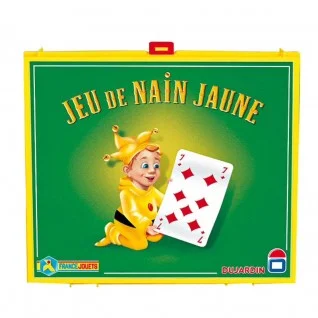
 Photo: BCD Jeux, partner shop
Traditional card games
Nain Jaune (Yellow Dwarf)
- players
- 3–8
- minutes
- 30
- years
- 8+
In the box
Nain Jaune board + 52-card deck + chips
Official rules (PDF, publisher's site)
Box details
- Origin
- Traditional game, with no specific designer or publisher
- Mechanics
- Betting and BluffingMemory
Where to buy it
Near you and online
In a shop
Within 50 km.
Online
Affiliate link: Marquoir may earn a commission, at no extra cost to you.
The basics
Three to eight players stake counters on the five bonus spaces of the board, then receive their cards: the aim is to get rid of them by playing sequences. You play upwards, regardless of suit, naming the missing card when you are stuck; playing a bonus card sweeps up the counters on its space. The first to play out collects one counter for each card left in the others’ hands, and the last player still in wins the game.
Checked against the official rules · October 2026
The rules, step by step
Setup
3 to 8 players, Counters on 5 spaces, 15 to 6 cards each
- Three to eight players, with the board, counters and a 52-card deck, jokers removed.
- The board has five spaces: the 10 of diamonds, the Jack of clubs, the Queen of spades, the King of hearts and the 7 of diamonds (the Nain Jaune, or Yellow Dwarf).
- Before each round, everyone places counters on the five spaces: traditionally 1 on the 10 of diamonds, 2 on the Jack of clubs, 3 on the Queen of spades, 4 on the King of hearts and 5 on the Nain Jaune. You can play for higher stakes.
- Each player is dealt 15 cards with three players, 12 with four, 9 with five, 8 with six, 7 with seven and 6 with eight. The rest forms a face-down stock, which is not used during the round.
How to play
Rising sequences, Name the missing card, Bonus card: sweep space
- The player to the dealer's right starts with the card that gives them the longest sequence, not necessarily an Ace, then carries on going up, regardless of suit: Ace, 2, 3, and so on.
- The sequence goes up to the King and stops there: it does not start again from the Ace.
- When they are stuck, they name the missing card ("without 8"): the next player continues the sequence if they hold that card, otherwise they pass.
- If nobody can continue, or the sequence has reached the King, the last player to have played a card starts a new one, from any card they like.
- Playing a bonus card lets you sweep up the counters on its space.
Scoring
1 counter per card left, Bonus card held: double, Grand Opéra: 5 spaces
- The winner of the round collects, from each opponent, one counter per card left in their hand.
- Anyone left holding a bonus card must double the stake on its space, which stays in play for the next round. If a bonus card is in the stock, its space is left as it is.
- Grand Opéra: a player who plays all their cards in one go sweeps up all five spaces, as well as one counter per card left in the other players' hands.
- The score sheet tracks the counter balance: enter a negative number when you pay.
End of the game
Can't pay: out, Last player in wins
- The round ends as soon as a player has played their last card.
- A player who can no longer stake or pay is out; the last player left wins the game.
- For a shorter game, stop at the first elimination: the player with the most counters wins.
House rules and pitfalls
The Nain Jaune is the 7 of diamonds: it gives the game its name and carries the biggest pot.
- The Nain Jaune is the 7 of diamonds: it gives the game its name and carries the biggest pot.
- Play your bonus cards as early as you can: any still in your hand at the end of the round makes you double the stake on its space.
Going further
Frequently asked questions · In the same family
Frequently asked questions
What is the game about?
Getting rid of your cards by building up sequences, while aiming for the spaces on the central board that win the counters staked — the Nain Jaune (7 of diamonds) being the biggest.
What are the board and its spaces for?
Five spaces each show a bonus card (10 of diamonds, Jack of clubs, Queen of spades, King of hearts and 7 of diamonds, the Nain Jaune). Before playing, everyone stakes counters on them; you win them by playing the matching card.
How does a turn work?
You play your cards in an ascending sequence, regardless of suit; the sequence stops at the King. When you are stuck, you name the missing card: the next player continues the sequence if they hold it, otherwise they pass. If nobody has it, the last player to have played a card starts a new sequence, from any card they like.
What happens when someone goes out first?
The round ends. The others pay the winner one counter per card left in their hand, and anyone holding a bonus card doubles the stake on its space. The spaces not won keep their stakes for the next round.
How do you win the game?
You play for the pot: a player who can no longer stake or pay is out, and the last one left wins. For a shorter game, stop at the first elimination and the player with the most counters wins. Playing the Nain Jaune to go out is the dream move — the bonus and the end of the round in one go.