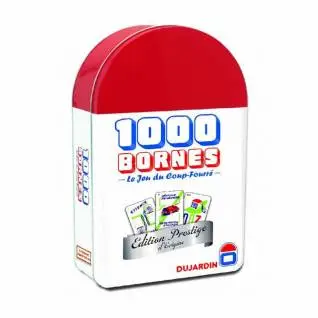
 Photo: BCD Jeux, partner shop
Card games
Mille Bornes
DujardinEdmond Dujardin1954
- players
- 2–8
- minutes
- 30
- years
- 8+
In the box
106 cards: distance, hazard, remedy and safety cards
Official rules (PDF, publisher's site)
Box details
- Designer
- Edmond Dujardin
- Artwork
- Hergé, Pierre Praquin
- Publisher
- Dujardin
- Mechanics
- Hand ManagementTake ThatTeam-Based
Where to buy it
Near you and online
In a shop
Within 50 km.
Online
Affiliate link: Marquoir may earn a commission, at no extra cost to you.
The basics
Be the first to total exactly 1,000 km with the cards laid in front of you, while slowing down your opponents. On your turn, draw a card, then play one, distance, hazard, remedy or safety, or failing that discard one; a hazard blocks an opponent until they play the matching remedy. The first to reach exactly 1,000 km wins; if the draw pile runs out of distance cards first, the player closest to 1,000 without going over wins.
Checked against the official rules · October 2026
The rules, step by step
Setup
6 cards each, The rest: draw pile, 2 to 4 players
- The current game has 110 cards: 106 playing cards and 4 reminder cards. Each player takes a reminder card; spare reminders are set aside.
- Distance cards: ten 25 km, ten 50 km, ten 75 km, twelve 100 km and four 200 km.
- Shuffle, deal six cards face down to each player; the rest goes into the draw pile.
- In front of you, leave room for a Battle pile, a Speed pile, Distance piles sorted by value and a row for Safeties.
- The youngest player starts, then play goes clockwise.
- Standard rules for 2 to 4 players; with 4 to 8 players, play in teams of two (see Notes).
How to play
Draw a card, Play or discard, End with 6 cards
- On your turn, draw a card, then play one or, if you cannot play anything, discard one: you always end with six cards in hand.
- Playing a distance card moves you forward that many kilometres. You may only play two 200 km cards in the whole game.
- A hazard goes on the Battle pile of an opponent who is moving: Stop (red light), Out of Gas, Flat Tire or Accident. Until it is covered by the matching remedy (Roll, Gasoline, Spare Tire, Repairs), they can no longer play distance cards.
- Speed Limit goes on the Speed pile: no distance cards above 50 km until End of Limit. It can be added to another hazard, but you never suffer two hazards at once on the Battle pile.
- You may attack even when you are under attack yourself.
- A safety protects you for the rest of the game and cancels the matching hazard already in place: Driving Ace against Accident, Puncture-Proof against Flat Tire, Extra Tank against Out of Gas, Right of Way against Stop and Speed Limit. Playing a safety lets you draw and play again at once.
- Coup fourré: when an opponent plays a hazard and you hold the matching safety, lay it down at once, even out of turn. Turn it sideways, refill your hand, then draw and play as if it were your turn; play then resumes on your left, and the players skipped lose their turn.
Scoring
No points in rulebook
- Current rulebook: no points. The first to exactly 1,000 km wins; if the draw pile has no distance cards left before that, the player closest to 1,000, without going over, wins.
- Traditional scoring from earlier editions, to play over several hands (not in the current rulebook): each kilometre travelled is worth one point.
- Hand completed at 1,000 km: 400 bonus points.
- Each safety played: 100 points. All four safeties: 700 points.
- Coup fourré: 300 points on top of the safety.
- Shutout, an opponent stays at zero km: 500 points. Extension, going on from 700 to 1,000: 200 points.
- Safe trip, finishing the hand without laying a single 200 km card: 300 points.
- Delayed action, playing the last card of the draw pile and finishing the hand: 300 points.
End of the game
Exactly 1,000 km, Otherwise, the closest
- Current rulebook: the game ends as soon as a player, or a team, reaches exactly 1,000 km, or as soon as there are no distance cards left in the draw pile.
- In the traditional points version, hands follow one another until a player totals 5,000 points.
House rules and pitfalls
In teams of two, each player keeps their own hand, but both partners advance on the same play area and each…
- In teams of two, each player keeps their own hand, but both partners advance on the same play area and each plays in turn.
- The current rulebook does not require a Roll (green light) to set off or to move again after a remedy: that rule comes from older editions, and many tables keep it.
Going further
Variants · Frequently asked questions · In the same family · Play with the game assistant
Variants
Game to
5000 points (traditional rule)
3,000 points (short game)
A single round
The first to 1,000 km wins, with no running total.
Format
Every player for themselves
In teams
In teams of two: two teams with four players, three with six. One column per team.
choose them when you start a game: the scorer adapts
Frequently asked questions
What is a coup fourré?
Laying down a safety as soon as an opponent plays the hazard it counters, even out of turn. The hazard is cancelled, you refill your hand and play again immediately. In the traditional scoring, it brings 300 points on top of the safety's 100.
Do you need a green light to set off or after a remedy?
Not according to the current Dujardin rulebook: once the hazard is fixed by its remedy, you may lay distance cards again. Older editions required a green light at the start and after every remedy; if your table plays that way, agree on it before the game.
What does the Speed Limit do?
It prevents you from laying distance cards above 50 km until you play End of Limit. It stacks with another hazard: you can be both limited and out of gas.
Can you attack when you are blocked yourself?
Yes, the rulebook explicitly allows it.
What is the extension?
A rule of the traditional scoring: when a hand is set to end at 700 km and the winner asks to carry on to 1,000, making it brings 200 extra points. The current rulebook does not include it.
Exactly how many kilometres do you need?
A thousand on the dot: a card that would take you over cannot be played. And you cannot lay more than two 200 km cards in the game.