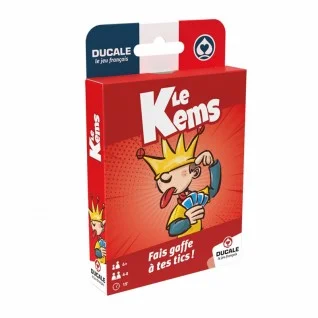
 Photo: BCD Jeux, partner shop
Traditional card games
Kemps
- players
- 4–8
- minutes
- 20
- years
- 7+
In the box
52-card deck
Box details
- Origin
- Traditional game, with no specific designer or publisher
- Mechanics
- Set CollectionSimultaneous Action SelectionTeam-Based
Where to buy it
Near you and online
In a shop
Within 50 km.
Online
Affiliate link: Marquoir may earn a commission, at no extra cost to you.
The basics
Four to eight players, in teams of two, each pair secretly agreeing on a signal: the aim is to collect four identical cards. Everyone plays at the same time, swapping cards with those in the centre, which are renewed when nobody wants to swap any more; as soon as a player has four of a kind, they make their signal and their partner calls Kemps, unless an opponent has spotted it and calls Counter-Kemps. The game is played to five points, or whatever is agreed.
The rules, step by step
Setup
Teams of 2, Secret signal agreed, 4 cards, 4 in the centre
- Four to eight players, in teams of two, partners sitting opposite each other. The number of players must be even.
- Before starting, each pair secretly agrees on a signal: a wink, a grimace, a finger on the table.
- Each player receives four cards, and four more are placed in the centre.
How to play
Simultaneous swaps, Four of a kind: signal, Partner calls Kemps
- Everyone plays at the same time: swap a card from your hand for one in the centre, as many times as you like.
- When nobody wants to swap any more, the dealer replaces the four cards in the centre with four new ones.
- As soon as a player has four of a kind, they make their signal. Their partner calls Kemps.
Scoring
Correct Kemps: 1 point, Counter-Kemps: 1 point, Wrong call: opponents +1
- Kemps called when the partner does not have four of a kind: the point goes to the opposing team.
- Counter-Kemps: an opponent who has spotted the signal can call it first, and wins the point.
- Enter 1 for the team that scores, or -1 for a wrong call.
End of the game
Played to 5 points, Or as agreed
- The game is played to five points, or whatever is agreed.
House rules and pitfalls
The real game is spotting the other pairs' signals, not collecting four of a kind.
- The real game is spotting the other pairs' signals, not collecting four of a kind.
never played?Aim of the game and full rules9 chapters · about 3 min read
Goal of the game
Kemps is played in teams of two. Each player tries to collect four cards of the same rank (four of a kind: four 7s, four Queens…). When one of them manages it, they discreetly make a secret signal to their partner, who must shout "Kemps!". But the opponents are watching for that signal: if they spot it, they can shout "Counter-Kemps!" and steal the point.
What you need
A 52-card deck. Four to eight players, always an even number: partners sit opposite each other, and the teams alternate around the table.
Choosing your signal
Before the game, each team steps aside for a few seconds to agree on a signal: a wink, touching your ear, pursing your lips, tapping the table twice… It must be visible enough for your partner and ordinary enough to go unnoticed. You can plan a second one meaning "careful, they are watching us".
Preparing a round
- The dealer deals four cards to each player, face down.
- They turn four cards face up in the centre of the table.
- They keep the rest of the deck in front of them.
- Everyone looks at their hand, and the dealer starts the game: "go!".
Play: everyone at once
There are no turns: everyone plays at the same time.
- You may take a card from the centre, provided you immediately put one from your hand in its place. You always keep four cards in hand.
- You swap as many times as you like, as fast as you like, one card at a time.
- When nobody wants to swap any more, the dealer announces "changing!", discards the four cards in the centre and turns over four new ones.
- When the deck runs out, shuffle the discards to carry on.
Calling Kemps
As soon as a player holds four of a kind, they make the agreed signal, without saying anything. Their partner must see it and shout "Kemps!" while pointing at them. The hand of the player pointed at is checked:
- if they do have four of a kind, their team scores 1 point;
- otherwise, the call is wrong, and the opposing team scores.
The player holding four of a kind cannot call it themselves: everything goes through the signal.
Counter-Kemps
If a player thinks an opponent has four of a kind (because they saw a signal, or because they saw them picking up four matching cards), they shout "Counter-Kemps!" while pointing at them. If the opponent does have four of a kind, the team that countered scores the point. Otherwise, the point goes to the team wrongly accused.
for example
Tom holds three Queens and sees the fourth appear in the centre. He takes it, then scratches his eyebrow. Léa, his partner, sees it and shouts "Kemps!". Tom shows his four Queens: one point for their team.
End of the round and of the game
Every call, right or wrong, ends the round: deal again. The first team to 5 points wins. In Marquoir, enter 1 for the team that scores, or −1 for the team that called wrongly.
Tips for beginners
- Change your signal between games: the opponents always end up finding it.
- Make fake signals when you have nothing: it keeps the opponents busy.
- Watch opponents who suddenly stop swapping: they may be waiting for their partner.
Going further
Frequently asked questions · In the same family
Frequently asked questions
What is the aim?
Collect four cards of the same rank in your hand, then make a secret signal agreed with your partner so they call "Kemps!" — without the opposing team spotting it.
How are cards swapped?
Cards are placed face up in the centre: everyone swaps continuously and in silence a card from their hand for one in the centre, until they have their four of a kind.
How do you win a point?
When a player sees their partner make the signal, they shout "Kemps!". If the four of a kind is really there, the team scores. But an opponent can shout "Counter-Kemps!" if they spotted the signal: they then steal the point.
Can the signal be anything?
Yes: a wink, touching your nose, a cough… Agreed in secret before the game. The whole art is making it look natural and changing it if the opponents have worked it out.
How long does a game last?
You play to an agreed score (often "Kemps" then "Double Kemps"). Bluffing and watching each other keep the tension going.