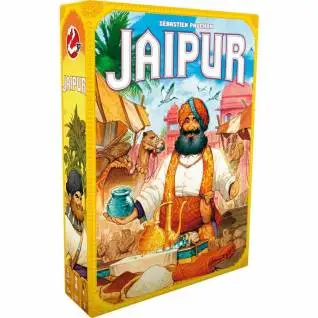
 Photo: BCD Jeux, partner shop
Card games
Jaipur
Space CowboysSébastien Pauchon2009
- players
- 2
- minutes
- 30
- years
- 10+
In the box
55 Goods and Camel cards · 38 Goods tokens · 18 Bonus tokens · 1 Camel token · 3 Seals of Excellence
Official rules (PDF, publisher's site)
Box details
- Designer
- Sébastien Pauchon
- Artwork
- Vincent Dutrait, Alexandre Roche
- Publisher
- Space Cowboys
- Mechanics
- Hand ManagementHidden Victory PointsMarketOpen DraftingPush Your Luck
Where to buy it
Near you and online
In a shop
Within 50 km.
Online
Affiliate link: Marquoir may earn a commission, at no extra cost to you.
The basics
A duel between traders: the richest player at the end of a round wins a Seal of Excellence, and the first to two seals wins. On your turn, either take cards from the market (one good, several by exchanging at least two for two, or all the camels) or sell cards of a single type for as many tokens taken from the top of the pile; diamonds, gold and silver sell two at a time at least, and your hand is limited to 7 cards. A sale of 3, 4 or 5 cards also earns a bonus token, and the largest camel herd is worth 5 rupees at the end of the round. The round stops as soon as three piles of goods tokens are empty or the deck can no longer refill the market.
Checked against the official rules · October 2026
The rules, step by step
Setup
2 players, 5-card market, 5 cards in hand
- Two players. Place 3 camels face up between the players, shuffle the other cards and deal 5 to each player; 2 cards from the deck complete the market, which always holds 5 cards.
- Any camels dealt to you leave your hand straight away: each player stacks them, face up, in front of them, and that pile forms their herd.
- The goods tokens are sorted by type, the highest value on top, and spread out so that every value stays visible.
- The bonus tokens are sorted by the sale they reward (3, 4, 5 cards), shuffled type by type and stacked without spreading them: their value, printed on the back only, stays hidden. The camel token goes next to them. The first player is chosen at random.
How to play
Take or sell, Never both, Only 1 type sold
- On your turn, you either take cards or sell cards, never both.
- What you take from the market is either goods or camels: you never combine the two in the same turn.
- Take a single good: replace it with the top card of the deck.
- Exchange: take several goods and give back to the market as many cards, from your hand or your herd; it is at least 2 cards for 2, and never the same type taken and given back.
- Take the camels: take all of them, put them in your herd, and the deck replaces the cards taken.
- Sell: discard as many cards of a single type as you like and take as many tokens of that type, starting from the top of the pile. Diamonds, gold and silver are sold 2 cards at a time at least, even when only one token of that good is left.
- At the end of your turn, you may not hold more than 7 cards; camels in your herd do not count.
Scoring
Goods tokens, Bonus from 3 cards, Largest herd: 5
- At the end of the round, the largest herd of camels takes the camel token, worth 5 rupees; in a tie, nobody takes it.
- Each player flips their tokens and counts their rupees: goods tokens, the camel token and bonus tokens, worth 1 to 3 rupees for a 3-card sale, 4 to 6 for 4 cards, 8 to 10 for 5 cards or more.
- The richest player wins a Seal of Excellence. If rupees are tied, the player with the most bonus tokens wins; if still tied, the one with the most goods tokens.
- In Marquoir, enter 1 each round for the player who wins the seal and 0 for the other; the counter stops at the first player to reach two seals.
End of the game
3 token piles empty, 2 seals to win
- A round stops on the spot as soon as three piles of goods tokens are empty, or when the deck can no longer refill the market.
- The game ends as soon as a player has 2 Seals of Excellence: they win. Otherwise, set the game up again for a new round, started by the loser of the previous one.
House rules and pitfalls
Taking many camels at once renews the market: your opponent may inherit fresh cards.
- Taking many camels at once renews the market: your opponent may inherit fresh cards. The rulebook suggests doing it rather when they already hold 7 cards: to take advantage of the new market, they will have to exchange.
- Waiting to make a big sale costs you dearly if your opponent empties the pile first: the top tokens are always the best.
- If fewer tokens are left than cards sold, the bonus token is still taken according to the size of the sale.
- The size of your herd can stay secret from your opponent.
Going further
Frequently asked questions · Rules on video · In the same family
Frequently asked questions
How many players is it for?
Two only: a duel between traders. You win the game by earning two Seals of Excellence (one per round won), over three rounds at most.
What do you do on your turn?
Either take cards from the market (one good, several by exchange, or all the camels), or sell one type of goods by discarding your cards for the matching tokens. You cannot do both.
Why sell quickly or wait?
A good’s tokens go down in value: the first ones sold are worth the most. But selling at least 3 cards at once earns a bonus token, all the bigger as the sale is big. Selling early is safe, selling big pays.
What are the camels for?
They mainly serve as currency to exchange several goods at once. At the end of the round, the player with the most wins the camel token, worth 5 rupees.
Can you keep as many cards as you like?
No: at the end of your turn, you may not hold more than 7 cards (camels in your herd do not count). That forces you to sell regularly.
What happens if rupees are tied?
The seal goes to the player with the most bonus tokens, then, if still tied, to the one with the most goods tokens.
Rules on video
- Rules video 1 · Videoregles.net
- Rules video 2 · Je vous explique les règles
- Rules video 3 · ExtraLife fr
Videos in French, hosted on YouTube.