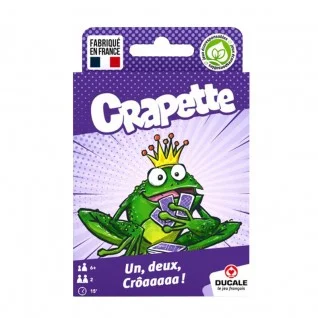
 Photo: BCD Jeux, partner shop
Traditional card games
Russian Bank
- players
- 2
- minutes
- 30
- years
- 8+
In the box
Two 52-card decks
Official rules (PDF, publisher's site)
Box details
- Origin
- Traditional game, with no specific designer or publisher
- Mechanics
- Hand ManagementPattern Recognition
Where to buy it
Near you and online
In a shop
Within 50 km.
Online
Affiliate link: Marquoir may earn a commission, at no extra cost to you.
The basics
Each player has their own 52-card deck: a crapette of thirteen cards, four cards in a line and a stock. On your turn, you play as long as you have a move, onto the Aces in the middle, the line or your opponent’s piles, then turn over the top card of your stock; if your opponent misses a compulsory move, you call Crapette and take over. The first to empty their crapette, stock and waste pile wins the round, and three rounds win the game.
Checked against the official rules · October 2026
Never played? Aim of the game and full rulesStep by step, with examples, for a first game.The rules, step by step
Setup
A 52-card deck each, Crapette of 13 cards, 4 cards in a line
- Two 52-card decks, one per player, with different backs.
- Each player makes a pile of thirteen cards, the crapette, with the top card face up, and four cards in a line in front of them.
- The remaining thirty-five cards form their stock, face down.
- The player whose crapette shows the higher card starts; in a tie, spades beat hearts, hearts beat diamonds, diamonds beat clubs.
How to play
Play as long as you can, Then turn your stock, Opponent error: Crapette
- You keep playing as long as you have a possible move, then you turn over the top card of your stock: if it cannot go anywhere, it goes on your waste pile and play passes.
- The Aces placed in the middle are built up by suit.
- You load your opponent's crapette and waste pile: a card of the same suit, one rank above or below the card showing.
- The four cards in the line are built down in alternating colours, red on black and black on red.
- If your opponent misses a compulsory move, you call Crapette and take over the play.
Scoring
No points, Rounds won counted
- No points: you count rounds won.
- Enter 1 for the winner of the round.
End of the game
Empty everything to win, 3 rounds won
- The round is won by the first player to empty their crapette, their stock and their waste pile.
- The first player to win three rounds wins the game.
House rules and pitfalls
It is a noisy game: half the fun lies in watching your opponent rather than your own cards.
- It is a noisy game: half the fun lies in watching your opponent rather than your own cards.
never played?Aim of the game and full rules8 chapters · about 4 min read
Goal of the game
Crapette is a patience game for two, played against each other on the same table. Each player has their own deck of cards. You must be the first to get rid of all your cards: first your crapette (a pile of thirteen cards), then your stock (talon). And at any moment, your opponent is watching: if they catch you out, they call "Crapette!" and take the play from you.
What you need
Two 52-card decks with different backs (one red, one blue): each player uses their own. You need a large table.
Setting up
The two players sit facing each other. Each shuffles their deck and lays out, on their side:
- The crapette: a pile of thirteen cards on their right, face down, except the top card, which is turned face up.
- The line: four cards face up in a column, between the two players. The four cards of each player form, with the opponent's, eight shared rows.
- The stock: the remaining thirty-five cards, face down, on their left. Next to it, a space for their waste pile (in French the écart, also called the pot).
The middle of the table stays clear: it will receive the eight Aces, one per suit and per deck. The player whose crapette shows the higher card starts. In a tie, the suit decides: spades beat hearts, hearts beat diamonds, diamonds beat clubs.
Where cards go
A card can go to three places, in this order of priority:
- In the middle, on the Aces: build up by suit, from Ace to King (Ace, 2, 3… of spades). As soon as an Ace is available, place it in the middle.
- On your opponent's piles, to load them: on the face-up card of their crapette or their waste pile, you place a card of the same suit, one rank above or below (on their 8 of diamonds, a 7 or a 9 of diamonds). Every card you give them is one more card they must get rid of.
- On the eight rows of the line: build down by one rank in alternating colours, red on black, black on red (a 6 of hearts on a 7 of clubs). An empty space can take any card. These rows act as a staging post: their cards end up in the middle.
You move only one card at a time, always a face-up, free card: the top of your crapette, the turned-up card of your stock, the top of your waste pile or the end of a row.
A turn
- First play what you can with the face-up cards: the top of your crapette, the cards at the ends of the rows.
- When the crapette card has been played, turn over its new top card.
- When you have nothing left to play, turn over the top card of your stock. If it can go somewhere, play it and carry on.
- If it cannot go anywhere, put it on your waste pile, face up: your turn is over, and it is your opponent's go.
- When your stock is empty, turn your waste pile over to make a new stock.
Priorities, and "Crapette!"
The order of moves is not free. You must:
- place in the middle any card that can go there, before any other move;
- load your opponent's crapette or waste pile rather than put on a row a card that could have gone there;
- play the card from your crapette whenever it can go somewhere, before touching your stock;
- turn over the new card of your crapette as soon as the previous one has gone.
If your opponent breaks one of these rules, you call "Crapette!" and point it out. If they were indeed at fault, their turn stops at once, and it is your turn to play.
for example
Léa turns over a card from her stock when her 2 of hearts, on her crapette, could have gone up onto the Ace of hearts in the middle. Tom calls "Crapette!": Léa stops, and Tom plays.
End of the round
The first player to empty their crapette, their stock and their waste pile wins the round. The first player to win three rounds wins the game; in Marquoir, enter 1 for the winner of each round.
Tips for beginners
- Empty the crapette first: it is what holds you back, and your opponent can load it.
- Load their crapette whenever you can: a card given is almost as good as a card played.
- Keep an eye on your opponent rather than your cards: every "Crapette!" wins you a turn.
- Play slowly at first: mistakes come from rushing.
Going further
Frequently asked questions · In the same family
Frequently asked questions
What is it, exactly?
A patience duel: two players, each with their own reserve, trying to get rid of their cards by building up central piles. The first to empty wins.
How do the central piles work?
Suits are built up on them from Ace to King. Any card that follows can be placed there by either player: the game is a mix of solitaire and race.
What does "crapette" mean?
When an opponent forgets a compulsory move or plays wrongly, you call "Crapette!": the play then passes to whoever spotted it. Vigilance is the whole game.
Where do players play from?
From their crapette (the reserve) first, then from their stock, and lastly from their waste pile; the cards at the ends of the columns, which go down in alternating colours, can be moved too. You must always make a compulsory move if there is one.
How does a round end?
As soon as a player has emptied their crapette, their stock and their waste pile. The game is played to three rounds won.