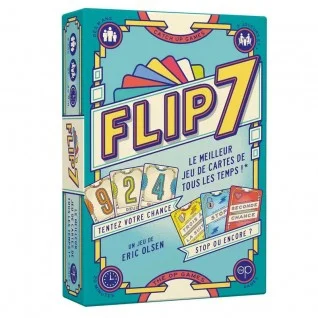
 Photo: BCD Jeux, partner shop
Card games
Flip 7
The Op GamesEric Olsen2024
- players
- 3–18
- minutes
- 20
- years
- 8+
In the box
94 cards
Official rules (PDF, publisher's site)
Box details
- Designer
- Eric Olsen
- Artwork
- O'Neil Mabile
- Publisher
- The Op Games
- Mechanics
- InterruptsPush Your LuckTake That
Where to buy it
Near you and online
In a shop
Within 50 km.
Online
Affiliate link: Marquoir may earn a commission, at no extra cost to you.
The basics
Round after round, flip Number cards without ever getting the same number twice, to be the first to reach 200 points. On your turn, say stay to keep your points or hit to receive a card: a number you already have makes you bust and score nothing, and seven different Numbers make a Flip 7, which scores 15 points and ends the round. At the end of a round in which someone has 200 points or more, the best total wins.
Checked against the official rules · September 2026
The rules, step by step
Setup
94 cards, Numbers from 0 to 12, 3 to 18 players
- The deck has 94 cards: 79 Number cards, 6 Modifier cards and 9 Action cards.
- Number cards: a single 0, a single 1, two 2s, three 3s… and so on up to twelve 12s. The higher the number, the more common it is.
- Modifier cards: x2, +2, +4, +6, +8 and +10, one of each.
- Action cards: Freeze, Flip Three and Second Chance, three of each.
- Shuffle the deck and draw lots for the first round's Dealer.
- The game plays 3 to 18 players; beyond that, add a second deck.
How to play
Stay or hit, Duplicate: you bust, 7 different: Flip 7
- To start the round, the Dealer deals one card face up to each player, themselves included, in turn order. An Action card that comes out during this deal is resolved at once, then the deal resumes.
- Then, starting on their left and ending with themselves, the Dealer asks each player still in: stay or hit?
- You can only stay if you have at least one card in front of you.
- Stay: the player leaves the round, turns their cards face down and will keep their points for the end of the round.
- Hit: the Dealer gives them one card face up.
- A number you do not have yet: you stay in the round. Line up your Numbers in front of you to keep track.
- A number you already have: you bust. The round ends for that player, who scores nothing and turns their cards over.
- A Modifier card goes above your Numbers: it never makes you bust, but it does not count as a Number. You may stay with a Modifier as your only card and score its value; the x2 alone, however, scores nothing.
- An Action card applies immediately: the player who receives it chooses to play it on themselves or on another player still in (see the notes).
- The round ends when all players are out (stayed or busted), or as soon as a player makes a Flip 7: seven different Numbers in front of them.
- The round's cards are set aside without being reshuffled; the deck passes to the player on the left, who becomes Dealer.
- When the deck runs out, shuffle the set-aside cards to make a new one; cards in front of players during the current round stay in place.
Scoring
Sum of Numbers, Numbers doubled by x2, Flip 7: +15
- Only players who did not bust score points.
- First add up the value of your Number cards (the 0 is worth nothing).
- With the x2 card, double that Number total.
- Then add the +2, +4, +6, +8 and +10 Modifier cards.
- Finally, a Flip 7 scores 15 more points.
- The x2 doubles neither the Modifiers nor the 15 points of the Flip 7.
- Example: 3, 5, 7, 10 and 11 make 36; with the x2, 72; with a +10 instead of the x2, 46.
End of the game
200 points reached, Tie: play on
- At the end of a round, if at least one player has 200 points or more, the game ends and the best total wins.
- There is only one winner: if players are tied in the lead above 200, everyone plays more rounds until a single player is ahead.
House rules and pitfalls
Freeze: target a player still in the round, who leaves it at once, keeping their points.
- Freeze: target a player still in the round, who leaves it at once, keeping their points. If you are the only one still in, you target yourself.
- Flip Three: target a player still in the round (yourself included, and necessarily if you are alone); they receive the next three cards. Dealing stops if they bust or make a Flip 7. A Second Chance drawn during those three cards can be set aside and used at once. A Freeze or another Flip Three counts among the three cards, but only applies once the three cards have been dealt, and only if the player has not busted; they can then target any player still in, themselves included.
- Second Chance: keep it in front of you. If a duplicate number comes later in the round, discard that number and the Second Chance, and stay in; your next card will come on the next go-round. It only protects you from a duplicate number, not from a Freeze.
- You can only hold one Second Chance at a time: a second one is given to another player still in who does not have one; if nobody can take it, it is discarded.
- All Second Chances are discarded at the end of the round, even if unused.
- In Marquoir, enter each player's total every round: 0 for anyone who busted.
Going further
Variants · Frequently asked questions · Rules on video · In the same family · Play with the game assistant
Variants
End of game
200 points (official)
100 points (short game)
choose them when you start a game: the scorer adapts
Frequently asked questions
Do Modifier cards count toward a Flip 7?
No. Only Number cards count: you need seven different ones. Modifiers do not make you bust either.
What is a Flip 7 worth with the x2 card?
The total of the seven Numbers is doubled, then the Modifiers are added, then the 15 points of the Flip 7, which are not doubled.
Two players pass 200 with the same total: who wins?
Nobody yet: everyone plays more rounds until a single player is in the lead. Marquoir's scorer waits for that tie-break before declaring the winner.
Can a player who stayed be targeted by a Freeze or Flip Three card?
No: those cards target a player still in the round.
Rules on video
Videos in French, hosted on YouTube.