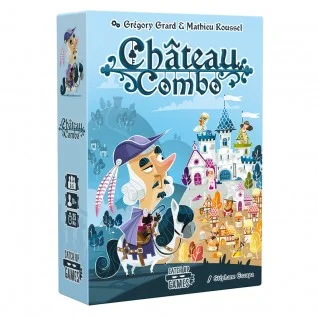
 Photo: BCD Jeux, partner shop
Card games
Château Combo
Catch Up GamesGrégory Grard, Mathieu Roussel2024
- players
- 2–5
- minutes
- 25
- years
- 10+
In the box
Château Combo deck
Box details
- Designers
- Grégory Grard, Mathieu Roussel
- Artwork
- Stéphane Escapa
- Publisher
- Catch Up Games
- Mechanics
- Multi-Use CardsOpen DraftingSet CollectionTagsTile Placement
- Expansions
- Château Combo: Au cachot! · 2025
Where to buy it
Near you and online
In a shop
Within 50 km.
Online
Affiliate link: Marquoir may earn a commission, at no extra cost to you.
The basics
Each player recruits nine characters and arranges them in a three-by-three grid, where each card scores according to its position and its neighbours. On your turn, you may spend a Key to move the Messenger or refresh its location, then recruit one of that location's three characters, paying its cost in gold or taking it face down for 6 coins and 2 Keys, and place it straight away. The game ends when everyone has placed their nine characters, and the highest total wins.
Checked against the official rules · October 2026
The rules, step by step
Setup
15 gold coins each, 2 Keys each, 3 Castle, 3 Village
- Two decks of 39 cards, Castle (grey backs) and Village (brown backs): reveal the top three cards of each in a row, the Village row below the Castle row. These are the characters available.
- A Messenger pawn placed next to the Village cards.
- Each player receives 15 gold coins and 2 Key tokens; the rest forms an unlimited supply.
- There is no board: each player builds a tableau in front of them that will end up as a grid of three cards by three. The first player is chosen at random.
How to play
1 optional Key, Recruit 1 character, Place the card
- On your turn, you may first, optionally, spend a single **Key**: either to move the Messenger to the other location, or to discard the three cards of the location where it stands and reveal three new ones.
- You **must recruit a character** from the three cards of the location where the Messenger stands, paying its cost in gold, minus the permanent discounts in your tableau (never below zero).
- You may always take one of those cards without paying and place it face down: it loses its effect and its points, but immediately earns you 6 gold coins and 2 Keys.
- You **place the card** straight away, orthogonally next to a card already placed, never putting more than three cards in a row or a column; then apply its effect, counting the card itself (a discount only applies from your next purchase).
- If the character's banner shows a Messenger icon, the Messenger moves to the location indicated; if not, or if the card was taken face down, it stays put. Each row is then refilled to three cards, and play passes to the next player, clockwise.
- The chosen position is final: the points of many cards depend on their neighbours, row, column or colour.
Scoring
Points from 9 characters, 1 point per Key
- Add up the points of each of the nine characters, according to their printed conditions, looking only at your own tableau. A face-down card scores nothing.
- These conditions relate to position (right-hand column, top row…), to the presence or absence of shields — six types: Nobility, Faith, Scholarship, Military, Craftsmanship and Peasantry —, to Castle or Village banners, or to the gold stored in the card's purse.
- Purses: at the end of the game, share out your remaining gold among your Purse cards, without exceeding the capacity printed on each. Gold left over scores nothing, but breaks ties.
- Add **1 point per Key** you still hold.
End of the game
Grids full, Highest total, Tie: most gold
- The game ends as soon as **every player has placed their nine characters** (full grid).
- Everyone does their scoring, Keys included.
- The highest total wins. Tie: the player with the most gold coins left wins; if the tie persists, the victory is shared.
House rules and pitfalls
The order of placement matters as much as the choice of cards…
- The order of placement matters as much as the choice of cards: a well-surrounded noble can be worth far more than an expensive character placed in the wrong spot.
- Keys are a constant dilemma: spend them to improve the offer, or keep them for a guaranteed 1 point each at the end of the game.
- Unless stated otherwise, an effect benefits the player who recruits and looks only at their own tableau; "opponents" means all the other players, "neighbour" the player on your left or right, as you choose.
- In English, the game is published as Castle Combo.
Going further
Frequently asked questions · Rules on video · In the same family
Frequently asked questions
How many cards do you place in total?
Nine, one per space of the 3×3 grid. As soon as everyone has filled their grid, the game ends: so you play exactly nine recruitment turns.
What are the Key tokens for?
One per turn at most, before recruiting: to move the Messenger, or to renew the three cards of the location where it stands, when the offer does not suit you. If not spent, each remaining Key is worth 1 point at the end of the game: keeping them is a choice that pays.
Can you move a character already placed?
No. Once placed, a card stays in its space. As many scores depend on neighbours, you need to plan how you build your grid.
What happens if I don't have enough gold?
You may always take a card without paying for it, by placing it face down: it gives neither effect nor points, but immediately earns you 6 gold coins and 2 Keys. Some effects also earn gold during the game: managing your purse is part of the game.
How is a tie broken?
The player who has kept the most gold coins wins; if the tie persists, the players concerned share the victory. Saving money without sacrificing points can therefore make the difference at the finish.
Rules on video
- Rules video 1 · Professeur Board Game
- Rules video 2 · Je vous explique les règles
- Rules video 3 · No Time No Game
Videos in French, hosted on YouTube.