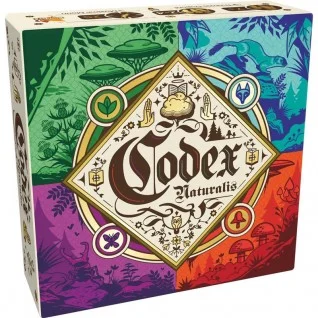
 Photo: BCD Jeux, partner shop
Card games
Codex Naturalis
BombyxThomas Dupont2021
- players
- 2–4
- minutes
- 25
- years
- 7+
In the box
40 resource cards · 40 gold cards · 6 starting cards · 16 objective cards · 9 pawns · 1 score track
Official rules (PDF, publisher's site)
Box details
- Designer
- Thomas Dupont
- Artwork
- Maxime Morin
- Publisher
- Bombyx
- Mechanics
- Hand ManagementLayeringOpen DraftingPattern Building
Where to buy it
Near you and online
In a shop
Within 50 km.
Online
Affiliate link: Marquoir may earn a commission, at no extra cost to you.
The basics
Lay out a manuscript in front of you by placing cards that cover the corners of earlier ones, scoring points as you place them and fulfilling objectives. On your turn, play one of the three cards in your hand on one or more visible corners, a gold card requiring the resources it shows, then take a visible card or the top card of a deck. As soon as a player reaches 20 points, finish the round, everyone plays one last time, then the objectives are added: the highest total wins.
Checked against the official rules · October 2026
The rules, step by step
Setup
3 cards in hand, 2 common objectives, 1 secret objective
- 40 resource cards, 40 gold cards, 6 starter cards, 16 objective cards, 9 tokens and a score track.
- Four resources: plant, animal, fungi and insect kingdoms. Three objects: quill, inkwell, manuscript.
- The resource cards form a deck whose top two cards are turned face up; the same for the gold cards. So four cards are visible in the centre.
- Each player draws a starter card at random, places it in front of them on the side of their choice, then takes two resource cards and one gold card into their hand.
- Two objective cards are turned face up beside the track: these are the common objectives. Each player then receives two objectives, keeps one secret and puts the other back under the pile.
- The first player is chosen at random; play then goes clockwise.
How to play
Play a card, On visible corners, Draw a card
- On your turn, you do two things in order: play one of the three cards in your hand, then draw one.
- The card played must cover one or more visible corners of the cards already in place, and never two corners of the same card. It always goes the same way up as its illustration, never turned round.
- Any card can be played face down: you give up its points, but the four corners on the back are always free and the central resource can no longer be covered.
- A gold card can only be played if the resources it requires are visible in the play area before it is placed. Whether they are covered afterwards no longer matters.
- You then take one of the four visible cards, which is replaced straight away, or the top card of one of the two decks.
Scoring
Placed: 1, 3 or 5 points, Objectives at the end
- Points scored on placement are recorded immediately: 1, 3 or 5 points depending on the card.
- Some gold cards score 2 points per corner covered by the card just played.
- Others score 1 point for each visible copy, in the play area, of the object they show (quill, inkwell or manuscript), including that card. An object added later scores nothing more.
- Objectives: 2 points per pair of identical objects, 3 points per set of three different objects, 2 points per set of three identical resources, 2 or 3 points per exact reproduction of a placement pattern — direction and colours included.
- When scoring objectives, each card in the play area is used only once per objective card.
End of the game
20 points reached, No cards left to draw, Everyone plays once more
- The end is triggered as soon as a player reaches or passes 20 points, or when there are no more cards to draw.
- The current round is finished, then everyone plays one last time.
- You then add the points from the two common objectives and your secret objective.
- The highest total wins. If tied, the player who scored the most points from objectives; if still tied, the victory is shared.
House rules and pitfalls
Covering your own resources is not a mistake: it is the heart of the game.
- Covering your own resources is not a mistake: it is the heart of the game. You sacrifice a mushroom to make room for a gold card worth five.
- The manuscript spreads out in all four directions: leave room on the table, the game rarely ends as a square.
Going further
Variants · Frequently asked questions · Rules on video · In the same family
Variants
End of game
20 points (official)
The first to reach 20 points triggers the last round.
30 points (long game)
The manuscript spreads out further, and the placement objectives become reachable.
choose them when you start a game: the scorer adapts
Frequently asked questions
How do you place a card?
It must cover at least one visible corner of a card already played, and never two corners of the same card. Only the corners of the card already in place matter: those of the card you are placing do not need to be free.
When can you play a gold card?
When the resources shown are visible in the play area at the moment it is placed. Covering them straight afterwards does not remove the card or its points.
What is the back of a card for?
To get you out of a fix: the back scores no points but offers four free corners and a central resource that can never be covered. It is the way to rebuild a base when the play area is getting cramped.
Does the game stop dead at 20 points?
No. Reaching 20 points triggers the end: you finish the current round, then everyone plays once more. Objectives are scored afterwards, and they often turn the ranking upside down.
Can the same card be used for several objectives?
Yes, for different objectives. Within the same objective, however, a card only counts once: three pairs of quills require six quills.
What happens if the decks are empty?
The end of the game is triggered as well. You finish the current round and everyone plays one last time, simply playing the cards left in their hand.
Rules on video
- Rules video 1 · Videoregles.net
- Rules video 2 · Professeur Board Game
- Rules video 3 · Je vous explique les règles
Videos in French, hosted on YouTube.