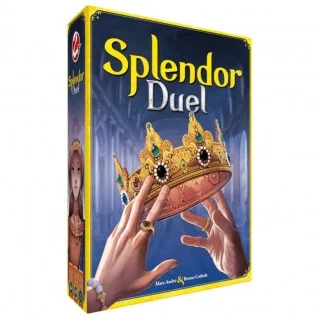
 Photo: BCD Jeux, partner shop
Tabletop games
Splendor Duel
Space CowboysMarc André, Bruno Cathala2022
- players
- 2
- minutes
- 30
- years
- 10+
In the box
Splendor Duel game
Official rules (PDF, publisher's site)
Box details
- Designers
- Marc André, Bruno Cathala
- Artwork
- Davide Tosello
- Publisher
- Space Cowboys
- Mechanics
- ObjectivesOpen DraftingRaceSet Collection
- Expansions
- Splendor Duel: Les Faussaires · 2026
Where to buy it
Near you and online
In a shop
Within 50 km.
Online
Affiliate link: Marquoir may earn a commission, at no extra cost to you.
The basics
Two players build up their engine of gems and Jewel cards to be the first to meet one of the three victory conditions. On your turn, take a single action: take up to three tokens in a line on the board, take a Gold and reserve a card, or buy a card by paying its cost minus your Bonuses. The game stops as soon as a player, at the end of their turn, has 20 prestige points, 10 crowns or 10 prestige points in a single colour.
Checked against the official rules · October 2026
The rules, step by step
Setup
25 tokens in a spiral, 3-level pyramid, Royal cards
- 25 tokens: four of each of the five gem colours (blue, white, green, black, red), two Pearls and three Gold, which act as wild cards. Place them at random on the 5×5 board, from the central space following the spiral.
- The 67 Jewel cards form three decks; reveal a pyramid of five level 1 cards, four level 2 and three level 3, under the Victory tile.
- The three Privileges go above the board, the four Royal cards below it.
- The first player is drawn at random; their opponent takes a Privilege.
How to play
1 action out of 3, Tokens in a line, Or buy a card
- On your turn, you take just one action out of three.
- **Take tokens**: up to three tokens in a line (row, column or diagonal) on adjacent spaces, never Gold this way.
- **Take 1 Gold and reserve a card**: you take a Gold token from the board and a card from the pyramid or the top card of a deck, kept hidden. Not allowed if there is no Gold left on the board or if you already have three reserved cards.
- **Buy a card**: pay the card's cost (from the pyramid or your reserve) minus your Bonuses; the tokens spent go back into the bag. A card taken from the pyramid is replaced by the next one of the same level.
- Before your action, in this order and if you wish: spend Privileges (each lets you take a Gem or Pearl token of your choice, never Gold), then refill the board with the whole contents of the bag, which gives your opponent a Privilege. A player who cannot take any mandatory action must refill the board first.
- When you should receive a Privilege and there are none left above the board, you take it from your opponent.
- Taking three tokens of the same colour, or both Pearls, also gives your opponent a Privilege. Some cards have an ability that applies when bought: take another turn, take a Privilege, take a token of the card's colour, steal a token (never Gold), or copy the colour of a Bonus you already have (cannot be bought without a card with a Bonus).
- At the end of your turn, you cannot keep more than ten tokens: the excess goes back into the bag. Reserved cards not bought cost nothing at the end of the game.
Scoring
Prestige points, 3rd, 6th crown: Royal, Prestige per colour
- The counter tracks the **prestige points** added up on the Jewel cards and the Royal cards.
- **Crowns** appear on some cards: the 3rd crown, then the 6th, let you take a Royal card (points and a power).
- You keep a separate eye on the prestige total **per colour**: it is one of the three ways out.
End of the game
20 prestige points, Or 10 crowns, Or 10 in one colour
- The game stops **immediately** as soon as a player, at the end of their turn, meets one of the three conditions:
- 20 prestige points in total (Jewel + Royal cards);
- 10 crowns;
- or 10 prestige points in a single Bonus colour.
- No tie is possible: the condition is checked at the end of a turn, only one player can trigger it, and the opponent does not get a last turn.
House rules and pitfalls
The three victories pull the game in three directions: going for crowns or a single colour can cut the ground…
- The three victories pull the game in three directions: going for crowns or a single colour can cut the ground from under an opponent who went for raw prestige.
- Refilling the board when it is half empty drops tokens that are easy to pick up on a diagonal: managing the refill is part of the duel.
Going further
Frequently asked questions · Rules on video · In the same family
Frequently asked questions
How many tokens can you take at once?
Up to three, provided they are adjacent and in a line (same row, same column or same diagonal). You can take fewer. There must be no empty space and no Gold token between them. Gold is never taken this way: only by reserving a card.
What are Privilege tokens for?
Before your action, each Privilege spent lets you take a Gem or Pearl token of your choice from the board (never Gold), on top of your normal action. You receive one when your opponent refills the board, takes three tokens of the same colour or both Pearls, or through certain cards: it is the consolation prize for the player on the back foot.
What happens if I go over ten tokens?
You cannot keep more than ten tokens in your reserve. If you go over, you put the excess back in the bag at the end of your turn.
Do a card's prestige points count towards the colour victory?
Yes: they count in the colour of the card's Bonus. That is why specialising in a single colour can reach 10 points well before you have 20 in total.
Can the game end by surprise?
Yes. As soon as one of the three conditions is met at the end of a turn, the game stops dead: so you must watch all three of your opponent's counters, not just their prestige.
Rules on video
- Rules video 1 · Videoregles.net
- Rules video 2 · Je vous explique les règles
- Rules video 3 · Professeur Board Game
Videos in French, hosted on YouTube.