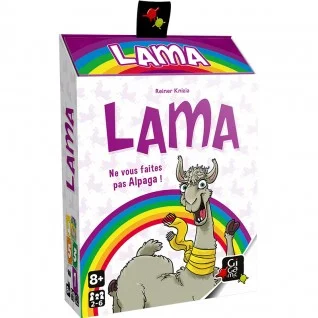
 Photo: BCD Jeux, partner shop
Card games
L.L.A.M.A.
GigamicReiner Knizia2019
- players
- 2–6
- minutes
- 20
- years
- 8+
In the box
56 cards: 8 of each value from 1 to 6 and 8 llamas · 70 chips: 50 white worth 1 point and 20 black worth 10 points
Box details
- Designer
- Reiner Knizia
- Artwork
- Rey Sommerkamp, Barbara Spelger
- Publisher
- Gigamic
- Mechanics
- Hand ManagementDiscardingPush Your Luck
Where to buy it
Near you and online
In a shop
Within 50 km.
Online
Affiliate link: Marquoir may earn a commission, at no extra cost to you.
The basics
Each player receives 6 cards. On your turn, you play onto the discard pile a card of the same value or one higher, a llama on a 6 or on a llama, a 1 on a llama; otherwise you draw, or you quit the round. The round stops as soon as someone has played all their cards or everyone has quit. Each player then takes chips for the value of their remaining cards, each value only once, llamas for 10; whoever emptied their hand may return a chip if they already have one. As soon as a player reaches 40 points, the lowest total wins.
Checked against the official rules · October 2026
The rules, step by step
Setup
6 cards each, 1 card turned face up, Chips in the middle
- 2 to 6 players, ages 8 and up, for about twenty minutes.
- The game holds 56 cards (8 of each value from 1 to 6 and 8 llamas) and 70 chips (50 white worth 1 point, 20 black worth 10).
- Shuffle the cards and deal 6 to each player, face down. The rest forms the draw pile, face down; turn over its top card next to it to start the discard pile.
- Place the chips in the middle, within everyone’s reach.
- The youngest player starts the first round.
How to play
Play: same or +1, Draw, Quit the round
- The game is played over several rounds, clockwise. On your turn, choose one action only: play a card, draw a card or quit the round.
- Play: the card showing on the discard pile decides. You may play a card of the same value or exactly one higher. On a 6, you may play a 6 or a llama; on a llama, another llama or a 1. The cards therefore go round in a loop: 1, 2, 3, 4, 5, 6, llama, then 1 again.
- Draw: add the top card of the draw pile to your hand, and your turn ends there. If the draw pile is empty, you must play or quit.
- Quit the round: instead of playing or drawing, you may always drop out, even with a playable card in hand. Lay your cards face down in front of you; they stay there until scoring, and you take no further part in the round.
- The round stops at once when a player has played the last card in their hand, or when every player has quit.
- When all the others have quit the round, the last player carries on as long as they can play, but no longer draws. When they cannot or will not play any more, they quit in turn and the round stops.
- For the next round, shuffle all the cards and deal again as in the setup; the player who ended the previous round plays first.
Scoring
Each value once, Llamas: 10, Empty hand: return chip
- At the end of a round, the cards each player has left, in hand or laid in front of them, cost them a penalty. A card is worth its value, a llama is worth 10 points.
- Each value counts only once: three 5s cost only 5 points, and two llamas 10 points.
- Rulebook example: with two 1s and a llama, you receive 11 points (1 + 10), that is one white chip and one black chip.
- These points are taken as chips: white worth 1 point, black worth 10 points. Ten white chips can be exchanged for a black one at any time, and the other way round.
- A player who has played all their cards and already holds chips from an earlier round may return one to the supply, white or black, as they choose. Thanks to the exchange, a player with at least 10 points can always return 10.
- In Marquoir, enter each player’s points every round, as a positive number (11 for two 1s and a llama); for a player who emptied their hand and returns a chip, enter −10 if their total is 10 or more, otherwise −1, never more than their total. As soon as a total reaches 40, the counter announces the winner, the player with the fewest points.
End of the game
40 points or more, Lowest total
- Play round after round until a player has 40 points or more.
- The lowest total wins; on a tie, the victory is shared.
House rules and pitfalls
In the French edition, the name stands for “LÂche ta MAin” (“let go of your hand”)…
- In the French edition, the name stands for “LÂche ta MAin” (“let go of your hand”); the English edition is called L.L.A.M.A.
- Quitting the round does not spare you from counting: the cards laid in front of you count like those in your hand.
- A player who empties their hand receives no points for the round. If they have no chips yet, they have nothing to return.
- The chip exchange, ten white for one black and the other way round, comes from Amigo’s original rules; the French rulebook does not mention it.
Going further
Frequently asked questions · In the same family
Frequently asked questions
Which card can you play in L.L.A.M.A.?
A card of the same value as the discard pile or exactly one higher. On a 6, you may play a 6 or a llama; on a llama, another llama or a 1.
How much do remaining cards cost?
Each value counts only once, at its face value; all llamas together are worth 10 points.
Can you come back into a round after quitting it?
No: a player who quits the round lays their cards in front of them and waits for the next round.
What do you gain by emptying your hand?
No points for the round, and the right to return a chip you already hold, white or black. With at least 10 points, you can always return 10.
When does the game end?
As soon as a player has 40 points or more. The lowest total wins; on a tie, the victory is shared.