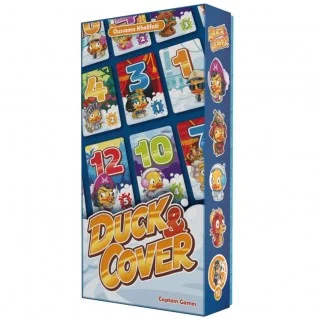
 Photo: BCD Jeux, partner shop
Card games
Duck & Cover
Captain GamesOussama Khelifati2024
- players
- 2–7
- minutes
- 20
- years
- 8+
In the box
84 Duck cards: 7 families of 12 cards numbered 1 to 12 · 26 Draw deck cards: two series of Captain cards from 1 to 12, one Max card and one Repeat card · 1 scorepad
Box details
- Designer
- Oussama Khelifati
- Artwork
- Adrien Journel
- Publisher
- Captain Games
- Mechanics
- Simultaneous Action SelectionLayering
Where to buy it
Near you and online
In a shop
Within 50 km.
Online
Affiliate link: Marquoir may earn a commission, at no extra cost to you.
The basics
Each player lays out their twelve ducks numbered 1 to 12 in a 4 by 3 grid. The Captain flips a card from the Draw deck and calls it out. Everyone, at the same time, moves their duck with that number: onto one of their own ducks right next to it, to cover it, or to an empty space beside one of their other cards. If that duck is already covered, you say “Quack”. The round ends when someone has only one stack left, or when the Discard area, where the cards nobody could play go, has received enough cards. Count the splashes on your visible ducks, as minus points if you finished in a single stack. After three rounds, the lowest total wins.
Checked against the official rules · October 2026
The rules, step by step
Setup
12 ducks per player, 4 by 3 grid, 26-card Draw deck
- For 2 to 7 players, aged 8 and up, for about twenty minutes.
- The box contains 84 Duck cards (7 families of 12 cards, numbered 1 to 12), 26 Draw deck cards and a scorepad.
- The Draw deck holds two series of Captain cards from 1 to 12, one Max card and one Repeat card.
- Each Duck card shows a number and a number of splashes. These splashes are the card’s points.
- Each player picks a family and shuffles its 12 cards.
- Each player lays out their 12 cards in front of them at random, face up, in a 4 by 3 grid (4 cards wide, 3 high).
- Unused families go back in the box.
- Shuffle the 26 Draw deck cards and place them face down in the middle of the table.
- Next to the Draw deck, leave space for two areas: the Captain pile, where cards stack up, and the Discard area, where they stay spread out.
- Choose a Captain. They flip and call out the cards. They also play, like everyone else.
How to play
Everyone at once, Cover or duck, Covered: “Quack”
- Each turn, the Captain flips the top card of the Draw deck and calls it out loud.
- All players must play their duck with that number at the same time.
- Each player chooses: cover or duck.
- Cover: place your duck on top of one of your own cards right next to it (above, below, left or right). Never diagonally.
- Duck: move your duck to an empty space, without covering any card. It must touch another of your cards along one side.
- When ducking, you may leave the starting grid or fill a gap.
- A card that moves always takes the stack it covers with it.
- “Quack”: if your duck with that number is already covered, you cannot play it. Say “Quack” instead.
- If all players say “Quack”, the Captain places the called card in the Discard area, face up.
- In the Discard area, the cards must stay spread out, all face up.
- Each time a card is discarded, the Captain says out loud how many there are, and how many more it takes to end the round.
- If at least one player could play, the card goes on the Captain pile. The cards of this pile go on top of one another: you only see the last one.
- Max card: each player plays their visible duck with the highest value (see Notes).
- Repeat card: it takes the value of the card flipped just before (see below).
- Repeat card right after a Max card: the Max card is played again.
- A Repeat card flipped as the very first card of the round, or right after a card that went to the Discard area, goes to the Discard area. It counts as a discarded card.
- When the Draw deck is empty, shuffle the Captain pile to make a new Draw deck. The Discard area stays where it is.
- Nobody may look through the Draw deck, the Captain pile or under covered cards (their own or anyone else’s) to find out what has already gone by.
- The round ends as soon as at least one player has gathered all their cards into a single stack.
- The round also ends as soon as the Discard area reaches its set number of cards. For 2 players → 9 cards; 3 → 8; 4 → 7; 5 → 6; 6 → 5; 7 → 4. Players plus discarded cards always make 11.
Scoring
Visible splashes, Single stack: negative
- At the end of the round, each player looks at their ducks that are still visible: the top card of each of their stacks. A single card on its own counts as a stack.
- Add up the splashes on these visible ducks.
- A player with more than one stack scores this splash total as plus points.
- A player who gathered their cards into a single stack scores the splashes of the top card as minus points.
- Rulebook example: Camille keeps the 6 and the 2, that is 2 + 1 splashes: +3. Hugo keeps the 1, the 4 and the 6, that is 0 + 2 + 2: +4. Léa keeps the 12 and the 6, that is 5 + 2: +7. Noé has only one stack left, topped by his 10 with 4 splashes: −4.
- So you can finish the game below zero.
- In Marquoir, enter each player’s score every round, plus or minus: the counter adds up the three rounds.
End of the game
3 rounds, Lowest total
- For a new round, the Captain shuffles the 26 Draw deck cards.
- Each player shuffles their family to make a new 4 by 3 grid.
- After the third round, add up the scores of the three rounds. The lowest total wins.
- In case of a tie, the winner is the player who was showing the fewest cards at the end of the third round (one visible card per stack).
- If still tied, the victory is shared.
House rules and pitfalls
The rulebook only calls for “Quack” when a duck is already covered: a visible duck must be played…
- The rulebook only calls for “Quack” when a duck is already covered: a visible duck must be played, and it always finds an empty space beside one of your cards to duck to.
- Max card: the French rulebook does not say whether “valeur” (value) means the number or the splashes; the publisher’s texts use the word in both senses. The English rulebook just says “their highest visible card”.
- Max card: unless the organiser has announced otherwise, Marquoir advises playing the highest number. That choice always points to a single duck, whereas two ducks can have the same number of splashes.
- The rulebook does not say whether the Captain changes from one round to the next: in a tournament, the organiser specifies it; failing that, the table agrees on it before the first round.
- In a tournament: the rulebook says nothing specific about tournaments. The organiser’s rules come first; without other instructions, play by the rulebook, with no variants.
- In a tournament: at the end of the third round, write down each player’s number of visible cards before picking everything up. It is used for the tiebreak (see End of the game).
- The publisher offers official variants on its website, to be chosen before the game. Among them: score the number of the cards instead of their splashes; double the minus points of the last round; remove the 1, 2 and 3 from the Draw deck, those ducks then only being able to move once covered; secretly remove two random cards from the Draw deck before each round; or flip two cards per turn, each player playing the one of their choice, without “Quack”, the round ending as soon as a player has a single stack.
- A cooperative variant from the publisher, for 2 to 5 players over two rounds, adds up the whole table’s scores to aim for the lowest team total.
- With the two extra families of the Artists Pack, you can play with up to 9 players: with 8 players, the round ends at 3 discarded cards; with 9 players, at 2 (the Marquoir counter goes up to 7 players).
Going further
Frequently asked questions · In the same family
Frequently asked questions
Can you cover a card diagonally?
No. To cover, the card goes onto a direct neighbour: above, below, left or right.
Where can you duck?
To any empty space, even outside the starting grid, as long as the card touches another of your cards along one side and covers none.
What happens when you move a card that covers others?
The whole stack it covers moves with it.
When do you say “Quack”?
When your duck with the number called is already covered. If the whole table says “Quack”, the card goes to the Discard area, which brings the end of the round closer.
What do you play on a Max card?
Your visible duck with the highest value; unless the organiser has announced otherwise, Marquoir advises the highest number (see Notes). The rulebook does not say so, but it follows from the rules: on a Max card, nobody says “Quack”. Everyone always has a visible duck, and that card can always duck. So the Max card always goes on the Captain pile.
Why is finishing in a single stack so worthwhile?
Because the splashes of the top card then count as minus points, and the round ends at once for everyone.
Who wins in case of a tie?
The player who was showing the fewest cards at the end of the third round (one visible card per stack). If still tied, the victory is shared.