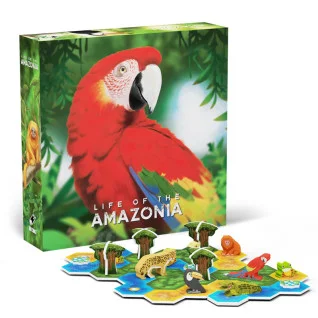
 Photo: BCD Jeux, partner shop
Tabletop games
Life of the Amazonia
Super MeepleJamie Bloom2023
- players
- 1–4
- minutes
- 60-150
- years
- 14+
In the box
1 Waterfall of Life to assemble, 2 token vaults and 4 discard pile boats · 66 base animal meeples and 8 unique animal meeples · 16 Base Animal cards, 8 Unique Animal cards, 42 Scenery cards and 48 Insect cards · 4 starting terrain tiles, 36 terrain tiles and 21 special terrain tiles · 42 trees, 42 aquatic flowers and 16 seeds · Resource tokens (Currency, Leaf, Water, Fruit), 8 Automa tokens and 1 Automa card · 4 bags, 16 player markers, 5 Complete tokens, 1 End Game Bonus token, 4 player aids and 1 scorepad
Box details
- Designer
- Jamie Bloom
- Artwork
- Sophia Kang
- Publisher
- Super Meeple
- Mechanics
- Bag BuildingTile PlacementHexagon GridPattern BuildingVariable Player PowersSolo Play
Where to buy it
Near you and online
In a shop
Within 50 km.
Online
Affiliate link: Marquoir may earn a commission, at no extra cost to you.
The basics
Each player builds their own jungle of hexagonal tiles and fills it with animals, trees and aquatic flowers, paying with the Resource tokens drawn from their bag. On your turn, you spend the tokens in your play area to chain as many actions as you can pay for, then you keep a few of them and draw 5 tokens. When 5 of the 8 Base Animal cards are empty, the other players play one last turn. Each player adds up their Base Animals, Scenery cards, three tracks, seeds and the End Game Bonus token: the highest total wins.
Checked against the official rules · October 2026
The rules, step by step
Setup
1 to 4 players, Bag of 10 tokens, 5 tokens face up
- 1 to 4 players, ages 14 and up. Solo play is against a virtual opponent, Black Comet (see Notes).
- Assemble the Waterfall of Life, which carries the four tracks (Terrain Tiles, Trees, Aquatic Flowers, Storage) and the bonuses for sale. Place the two Resource token vaults within everyone’s reach.
- Choose a Base Animal set among A, B, C and D (A for a first game) and lay its 8 cards in the middle: this is the Animal Refuge. The same animal does not score the same way from one set to another.
- Next to each card, take its meeples: 3 per player (woodpeckers, leaf frogs, tamarins), 2 per player (toucans), the number of players plus 2 (macaws, caimans), the number of players plus 1 (giant otters, jaguars); with 1 or 2 players, count 2. The rest stay in the box. The Complete tokens and the End Game Bonus token wait near the cards.
- Shuffle the Terrain Tiles and reveal 3. Shuffle the Insect cards and the Scenery cards into two decks, and reveal 3 cards from each.
- Seeds, trees, aquatic flowers and Special Terrain Tiles form the supply.
- Each player chooses a colour and receives a random starting tile, a bag, the discard pile boat of their colour and 4 markers placed on the first space of each track.
- Each bag receives the same 10 tokens: three Currency 1, two Currency 2, two Leaf 1, two Water 1 and one Fruit 2.
- Each player receives 2 Unique Animal cards, keeps one and places the matching meeple on it; if the card shows a starting seed, they take it.
- Play goes clockwise. With three or four players, the third and fourth players receive a seed.
- Each player draws 5 tokens from their bag and lays them face up in front of them: this is their play area.
How to play
8 possible actions, No change given, Draw 5 tokens
- A turn has two phases: actions, then clean-up.
- To act, you discard tokens from your play area into your boat. As long as you can pay, you chain actions, the same one several times if you like.
- The eight actions: buy a Resource token; place a Terrain Tile; place a tree; place an aquatic flower; place an animal; buy a Nature card; increase your storage; buy a bonus.
- Each price shows one or more resources, with their type (Currency, Leaf, Water or Fruit) and their value: you pay each one with tokens of that type, whose values add up.
- A payment covers only one type of action, possibly repeated: you must then pay for it all at once. Anything above the price is lost; no change is given.
- Any two tokens can replace a resource of value 1, whatever their values. A seed is also worth a resource of 1 of your choice; it then goes back to the supply. You never keep more than 4 seeds: any seed received beyond that is lost.
- A token you buy goes into your boat. When you must draw and your bag is empty, the boat is emptied back into it.
- Terrain Tiles, trees and flowers are paid for by moving your marker one space up the matching track, at the price of that space. The space’s bonus is yours; a limited bonus goes only to the first to arrive (the first two with 4 players). At the end of a track, the action is no longer possible. The new tile must touch your jungle along at least 2 hexes. A tree goes on a free forest hex, a flower on a free river hex.
- A Base Animal is paid for at the price on its card and goes on free hexes that match the card. A Unique Animal costs nothing, but its placement conditions must be met. Its power only works once the animal is placed, and once per turn.
- Only one living thing per hex: animal, tree or flower. Placing a living thing on a hex that shows a bonus earns you that bonus; a Special Terrain Tile placed on it does not.
- The six bonuses: move a living thing, compost a token, place a Special Terrain Tile, gain a seed, draw a token, refresh the cards or tiles on offer. When buying, each type of bonus can be taken only once per turn.
- When a Base Animal card has no meeples left, put a Complete token on it: that animal can no longer be placed.
- Nature cards: a Scenery card is kept for scoring, 4 at most; an Insect card applies at once and is then discarded.
- Clean-up: keep in your play area as many unused tokens as your Storage track allows (1 at the start, 3 at most); the rest go into your boat. Then draw 5 tokens.
Scoring
End Game Bonus: 5 points, 3 scoring tracks, Seed: 1 point
- Everything is scored at the end of the game, in the order of the scorepad.
- Base Animals: each card of the Animal Refuge says how its animals placed in your jungle score, per animal, per group, per community or across the whole jungle. Unique Animals score nothing by themselves, but they count as animals for the cards and for the tie-breaker.
- For any one card, a tree, a flower or an animal belongs to only one group; it can be used again when scoring other cards.
- Scenery cards: each one scores according to its condition.
- Terrain Tile, Tree and Aquatic Flower tracks: the points of the space your marker is on. The first spaces of the Terrain Tile track are worth nothing.
- Seeds: 1 point per unused seed (4 at most).
- End Game Bonus token: 5 points for the player who emptied the fifth Base Animal card.
- Rulebook example, with set A: 80 points for the Base Animals (8 for the woodpeckers, 12 for the tamarins, 8 for the toucans, 10 for the macaws, 18 for the giant otters, 24 for the jaguars, nothing for the leaf frogs and the caimans), 22 for two Scenery cards, 0, 6 and 2 on the Terrain Tile, Tree and Flower tracks, and 2 seeds: 112 points.
- In Marquoir, enter the points of each of the eight Base Animals, of the Scenery cards and of the three tracks, then the number of seeds left, and 1 for the End Game Bonus token for whoever took it: the counter adds 1 per seed and 5 for the token.
End of the game
5 empty Animal cards, 1 last turn, Highest total
- As soon as 5 of the 8 Base Animal cards are empty, the player who placed the last meeple of the fifth one takes the End Game Bonus token. They finish their turn as usual.
- Then each of the other players plays one last turn, and the game stops.
- The highest total wins. On a tie, the player with the most animals in their jungle wins; otherwise, the tied players share the victory.
House rules and pitfalls
Lightning Mode, for two to four players: fewer meeples per animal, as shown in the rulebook’s table…
- Lightning Mode, for two to four players: fewer meeples per animal, as shown in the rulebook’s table, and just before scoring each player places for free 1 tree, 1 flower and 1 Special Terrain Tile, with no bonus, no Unique Animal power and no effect on the tracks; if there is no room, nothing is placed. It is not played solo.
- Solo: against Black Comet, over 20 turns, in one of the rulebook’s 9 scenarios, each with its own Base Animal set (free choice for the first scenario), its own side of the Automa card and sometimes its own rules. Some spaces of the Automa card give the player a bonus. Black Comet does not build a jungle: its tokens remove animals from the Animal Refuge, discard Nature cards and move its markers up the Tree and Flower tracks.
- Solo, the game stops at the end of the twentieth turn, not when 5 cards are empty, and the 5 points of the End Game Bonus token do not count. Your final score is your total minus Black Comet’s points on the Tree and Flower tracks, plus or minus the points set by the scenario. It is compared with the scenario’s three targets: gold, silver or bronze; below bronze, the scenario is lost.
- In Marquoir, the Solo mode adds the Black Comet and scenario lines, and removes the End Game Bonus token line.
Going further
Variants · Frequently asked questions · In the same family
Variants
Game mode
Multiplayer game
Two to four players. The shorter Lightning Mode is scored the same way.
Solo
Against Black Comet, over 20 turns, in one of the rulebook’s 9 scenarios, each with its own Base Animal set (free choice in the first). No End Game Bonus token; Black Comet’s points on the Tree and Flower tracks are subtracted. The total is compared with the scenario’s gold, silver and bronze targets.
choose them when you start a game: the scorer adapts
Frequently asked questions
Can you pay for two different actions with a single token?
No. A payment covers only one type of action, which you may repeat. The surplus of a token that is too big is lost.
What if you lack the right type of resource?
Any two tokens replace a resource of value 1, and so does a seed. You can do this as many times as you like.
Who triggers the end of the game?
The player who places the last meeple of the fifth Base Animal card to be emptied. They gain 5 points, finish their turn, then each of the others plays once more.
How many Scenery cards can you keep?
4 at most. To take a fifth, you must discard one. Insect cards do not count towards this limit.
What happens on a tie?
The player with the most animals in their jungle wins. If the tie remains, the victory is shared.